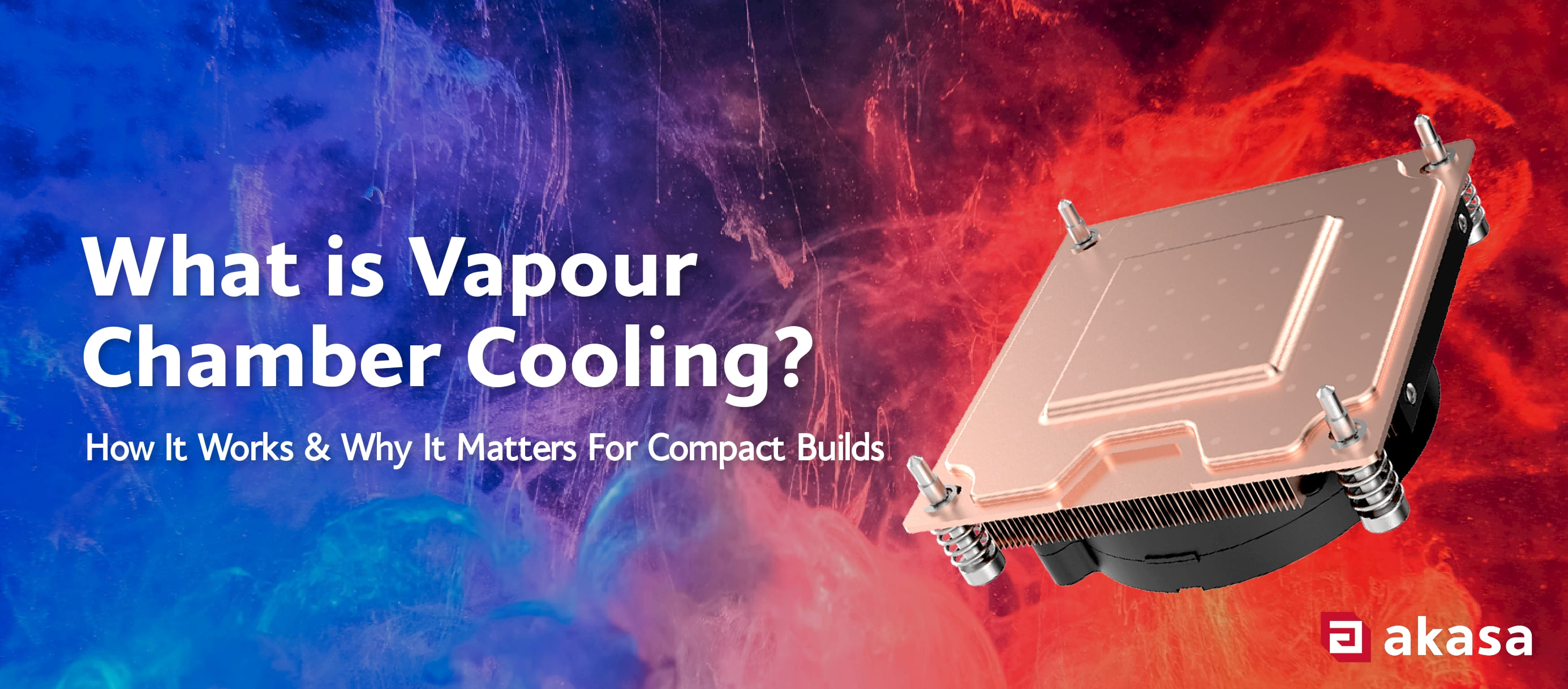
 If you've been browsing CPU coolers lately, you've probably started seeing the words "vapour chamber" popping up more and more. Once found mainly in high‑end laptops and enterprise server racks, this technology is now making its way into the consumer PC cooling space for good reason. But what exactly is a vapour chamber, how does it work and is it actually better than a traditional heatsink with heatpipes?
The Problem With Heat: Why Spreading It Matters
Before getting into vapour chambers specifically, it helps to understand the fundamental challenge of CPU cooling: heat spreading.
Modern CPUs do not generate heat evenly across their entire surface. Instead, heat is concentrated in small, intensely hot areas known as hotspots, located directly above the most active cores. A traditional heatsink sitting flat on top of your CPU can only move heat as quickly as the metal allows, while aluminium and copper are good conductors, they still have limits. This is why heatpipes were such a breakthrough, as they use the latent heat of a working fluid to transfer heat far more efficiently than solid metal alone.
A vapour chamber takes that same core principle and extends it across two dimensions rather than one.
What is a Vapour Chamber?
A vapour chamber is a sealed, flat metal enclosure, typically made of copper, containing a small amount of working fluid (most commonly distilled water or a similar low-boiling-point fluid) and a porous wick structure lining the interior walls.
Here is what happens when your CPU starts generating heat:
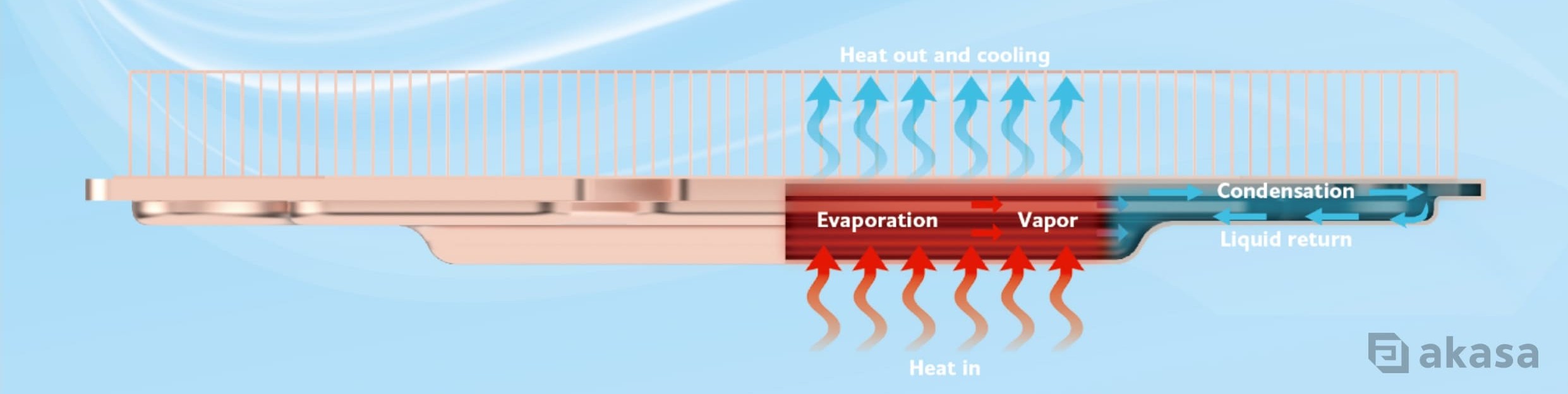
- Evaporation: The working fluid in contact with the hot CPU surface absorbs heat and evaporates almost instantly into vapour.
- Spreading: That vapour expands rapidly and spreads uniformly across the entire internal surface of the chamber in all directions simultaneously.
- Condensation: As the vapour reaches the cooler edges and top surface of the chamber, it condenses back into liquid, releasing the absorbed heat into the heatsink fins.
- Return: The wick structure draws the condensed liquid back to the hot spot via capillary action and the cycle repeats again.
The result is highly efficient heat distribution across the entire base of the cooler almost instantaneously. This reduces localised hotspots and ensures the full surface area of the heatsink is being used effectively, rather than just the small section directly above the CPU die.
Vapour Chamber vs Traditional Heat Pipe: What’s the Difference?
Both methods rely on phase-change heat transfer, using evaporation and condensation, but their geometries are fundamentally different.A heatpipe is a narrow, sealed tube. Heat enters at one end (the evaporator), moves along the pipe as vapour and exits at the other (the condenser). This design works extremely well in tower coolers, where multiple heatpipes carry heat from a wide base up into a tall stack of fins.
A vapour chamber can be thought of as a flattened heatpipe that spreads across an entire surface. Instead of a few linear pathways, it provides a continuous two-dimensional thermal plane. This allows heat to move in any direction rather than along a fixed path, making it especially effective at handling hotspots that do not align neatly with heatpipe routing.
| Feature / Cooling | Vapour Chamber | Heat Pipe |
| Basic Structure | Flat sealed chamber | Round or flattened tube |
| Heat Spreading Area | Full planar (2D spread) | Linear (1D spread) |
| Hot Spot Handling* | Excellent | Good |
| Thickness | 0.3-3.0 mm | 1.5-10 mm |
| Manufacturing Complexity | Higher | Lower |
| Typical Application | Laptops, 1U servers, Small Form Factor (SFF) PCs | Full-size desktop coolers |
In practice, for a standard mid-tower system with plenty of vertical clearance, a well-designed heatpipe cooler can be every bit as effective as a vapour chamber (and often more cost effective). Vapour chambers show their advantage in space-constrained environments, such as thin laptops, compact SFF systems and 1U rackmount servers, where there is not enough room for a tower cooler.
The Physics Behind It: Why It's So Efficient
The reason both heatpipes and vapour chambers are so thermally effective comes down to latent heat of vaporisation. When a liquid evaporates, it absorbs a very large amount of energy relative to its mass, far more than simply heating the same liquid to a higher temperature. That energy is then carried with the vapour and released when it condenses, which makes phase-change heat transfer dramatically more efficient than conduction through solid metal alone.Copper, for context, has a thermal conductivity of around 400 W/m·K (already excellent), yet a well-designed vapour chamber can move heat far more effectively than solid copper alone. That's because instead of relying on the metal itself to slowly conduct heat from one point to another, the vapour chamber actively carries heat across its surface via the movement of evaporating and condensing fluid: a much faster process.
The wick structure inside is equally important. It has to be fine enough to generate sufficient capillary pressure to draw liquid back against gravity but porous enough not to restrict fluid flow. Sintered copper powder, grooved surfaces and wire mesh are all common wick designs, each with different trade-offs between capillary pressure and flow resistance.
Where Is Vapour Chamber Cooling Used?
Vapour chambers have been a staple of high-end laptop cooling for years. If you own a gaming laptop or a thin and light workstation, there is a good chance you have been benefiting from one without realising it. They are also widely used in:- Smartphones and tablets
- High-performance graphics cards
- 1U rackmount servers
- Edge computing and embedded AI platforms
- Medical and industrial equipment
Increasingly, they are appearing more frequently in desktop CPU cooling, particularly in the growing low-profile and SFF cooling segment.
Vapour Chamber CPU Coolers for SFF and Thin Builds
This is arguably where the technology is most interesting right now for PC builders. Mini-ITX and Thin Mini-ITX builds demand high-performing cooling solutions in ever-smaller space and vapour chambers are well suited to meet that challenge.In a low-profile design, thermal performance is constrained by how efficiently the base can conduct heat to the fins. Replacing the solid copper or aluminium base with a vapour chamber means heat spreads rapidly across the entire base and every fin sees the same temperature, improving overall thermal performance without adding height.
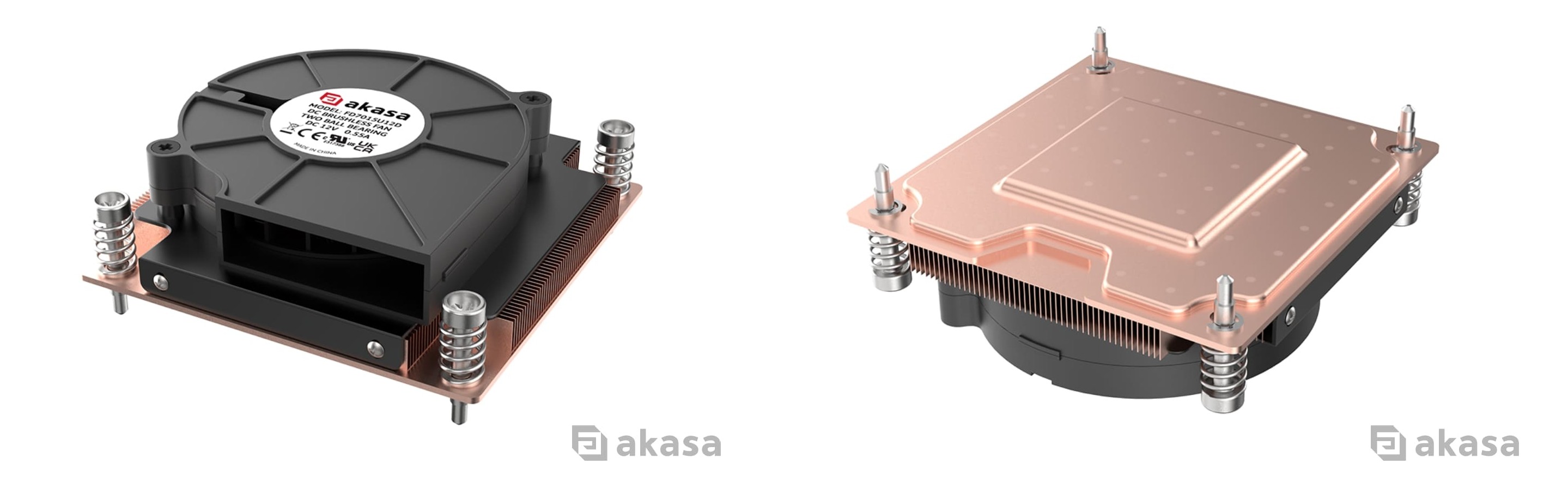
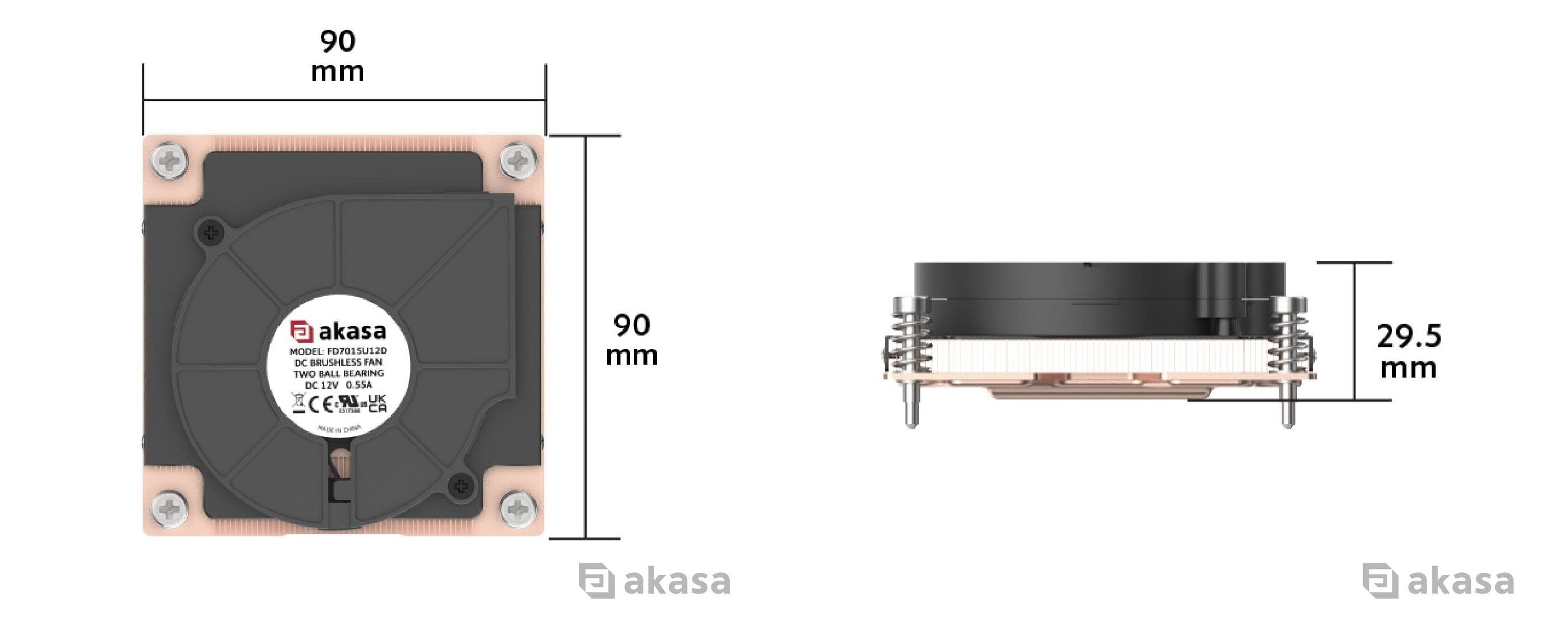
The AK-CC7409BP01 is a low-profile CPU cooler that integrates a copper vapour chamber heatsink within a slim 29.5mm tall design for Intel LGA1851 and LGA1700 socket-based processors up to 125W TDP. Paired with a UL-certified side blower fan with PWM control from 1200 to 5500 RPM and a rated lifespan of 80,000 hours, it is well-suited for demanding, continuously running systems such as 1U servers, edge AI devices and compact industrial PCs, where both effective cooling and long-term reliability are important.
Is Vapour Chamber Cooling Right for You?
The answer depends on your build.For a standard mid tower or full tower system, a multi-heatpipe cooler will perform very well and can offer better value. The advantage of a vapour chamber becomes more noticeable when vertical space is limited and efficient heat spreading across a flat surface is the primary challenge.
For compact systems such as SFF PCs, 1U servers or embedded industrial platforms, vapour chamber cooling offers strong thermal performance within a compact footprint, fitting in environments where traditional heatpipe towers cannot. As CPUs push higher TDPs and builds trend smaller, it is a technology that will only become more relevant.
About Akasa
Akasa is a global computer hardware and electronics manufacturer which fuses innovative design with cutting-edge technology and engineering to deliver exceptional products for our customers. Founded in 1997, Akasa has extensive expertise to provide quality solutions to suit your needs. We offer passive and active case solutions, coolers, heatsinks, fans, PC lighting and a vast array of card readers, cables, and adapters.Legal Notices
© Copyright 2026 Akasa. All rights reserved. Akasa is a trading style of the Akasa group of companies. All trademarks and registered trademarks are the property of their respective owners. This article is intended for general informational purposes only and does not constitute professional or technical advice. Product performance may vary depending on system configuration, operating conditions and workload. Specifications, performance figures, features and availability are subject to change without notice. Always refer to official installation manuals for guidance. Images are for illustrative purposes only. To the extent permitted by law, Akasa accepts no liability for any loss or damage arising from reliance on the information contained herein.

