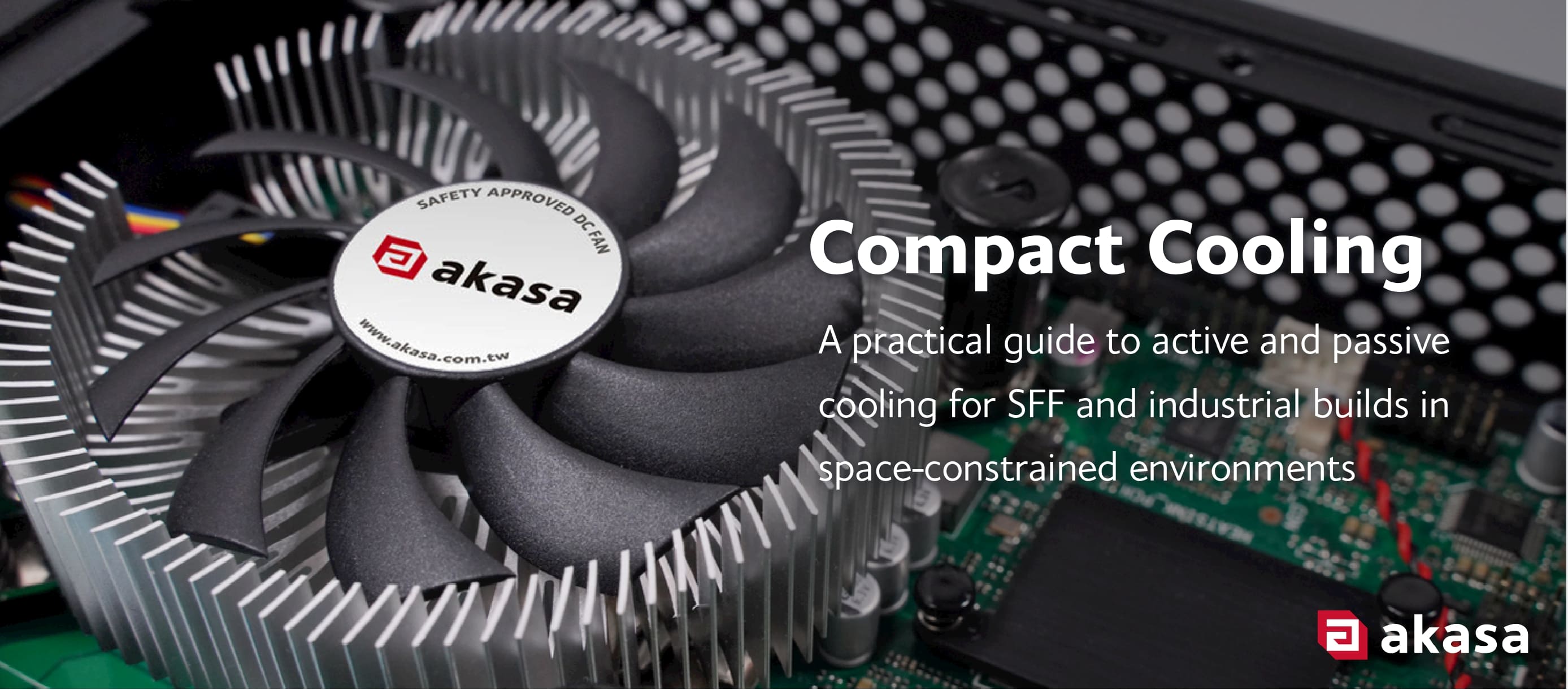
 If you've been looking at building a smaller PC, whether that's a quiet home theatre PC (HTPC), a tidy desk setup, or a long-life industrial system, you've likely seen the term "compact cooling." But what does it actually mean and how is it different from standard PC cooling? Whether you're new to small form factor (SFF) builds or looking to refine your approach, here's what you need to know.
What Is Compact Cooling?
Compact cooling refers to thermal management designed specifically for space-constrained PC environments: cases, coolers and system designs engineered to keep processors running safely within small footprints, where a tower cooler, 120mm+ radiator, or full-size ATX case simply won't fit.
It applies most directly to Mini-ITX, Thin Mini-ITX, SFF, and HTPC builds. These form factors trade expandability for footprint, which raises a core engineering question: how do you keep a modern CPU from throttling when there are only a few centimetres of clearance above the motherboard?
The answer lies in purpose-built low-profile coolers, fanless cases and carefully considered airflow strategies, all of which fall under the broader umbrella of compact cooling.
Why Would You Want Compact Cooling?
The reasons for a compact system tend to come down to four main themes:
- Space and aesthetics: A Mini-ITX or Thin Mini-ITX system on a desk, in a media cabinet, or VESA-mounted behind a monitor takes a fraction of the space of a mid-tower.
- Low-noise operation: Fanless cases can deliver silent acoustics that a standard tower build with active coolers cannot match. This is particularly relevant for HTPCs, media servers, and office PCs.
- Long-life and embedded use: Industrial computing, digital signage, point-of-sale terminals, kiosks and edge AI deployments need capable processing in tight enclosures, often running for years with minimal maintenance.
- Mounting flexibility: Many compact cases support VESA or wall mounting, opening up placement options that aren't practical with larger chassis.
The trade-off is thermal headroom. Smaller cases offer less heatsink mass and less airflow, so component selection (particularly CPU TDP) needs to align with the case and cooler's rated thermal capacity.
The Growing Role of Edge and Embedded Computing
Computing increasingly runs at the edge, closer to where data is generated. Edge platforms handle real-time data processing, machine vision, and on-device inference in environments where conventional servers aren't practical: factory floors, retail spaces, medical equipment, vehicles, and remote installations. These systems often run continuously with limited maintenance access.
Modern processors are also integrating more capability into the same package. Intel's Core Ultra series, for example, brings CPU, GPU, and NPU (Neural Processing Unit) cores together on platforms that fit Mini-ITX and Thin Mini-ITX boards. More integrated silicon generally means more heat to manage in the same footprint, which is exactly the constraint compact cooling is designed to address.
The result is a growing overlap between enthusiast SFF builds and industrial PC design. The same Mini-ITX platform behind a quiet office machine can, in another configuration, serve as a controller in an embedded application.
Active vs Passive: Two Approaches to Compact Cooling
When it comes to removing heat from the processor in a compact system, there are two fundamentally different strategies: active cooling and passive cooling.
Active Compact Cooling
Active cooling uses a fan, typically a low-profile or embedded one, to move air across a heatsink and out of the case. In compact builds, this usually means a CPU cooler between roughly 20mm and 30mm tall with a small embedded fan. The advantage is thermal capacity, even a modest fan significantly increases the heat that can be shifted compared to passive cooling. The trade-offs are some audible noise during high load and the routine maintenance that comes with any mechanical component.
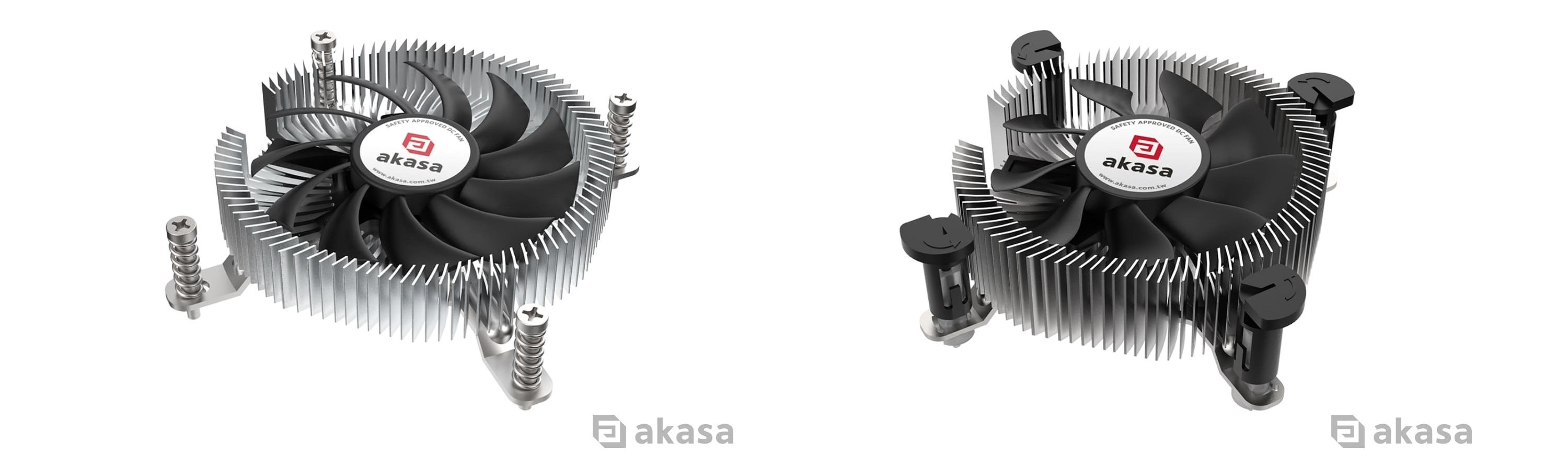
In practical terms, compact active coolers in this height range differ mainly by core material, fan design, socket compatibility, mounting method and TDP capacity. For example, the Akasa AK-CC6609EP01 uses an aluminium core with a PWM-controlled C-blade fan at only 21.8mm height. Designed for LGA1851 and LGA1700 socket-based processors up to 35W TDP, it uses a screw mount system suited to industrial and embedded platforms with lower thermal requirements. Where more cooling performance is needed, the AK-CC6616HP01 and AK-CCE-7106HP both support processors up to 73W TDP with a copper core and S-FLOW PWM fan, the former features a 29.92mm profile height with screw mounting for LGA1851 and LGA1700 sockets, the latter features a 29.5mm push-pin design for LGA1200 and earlier sockets.
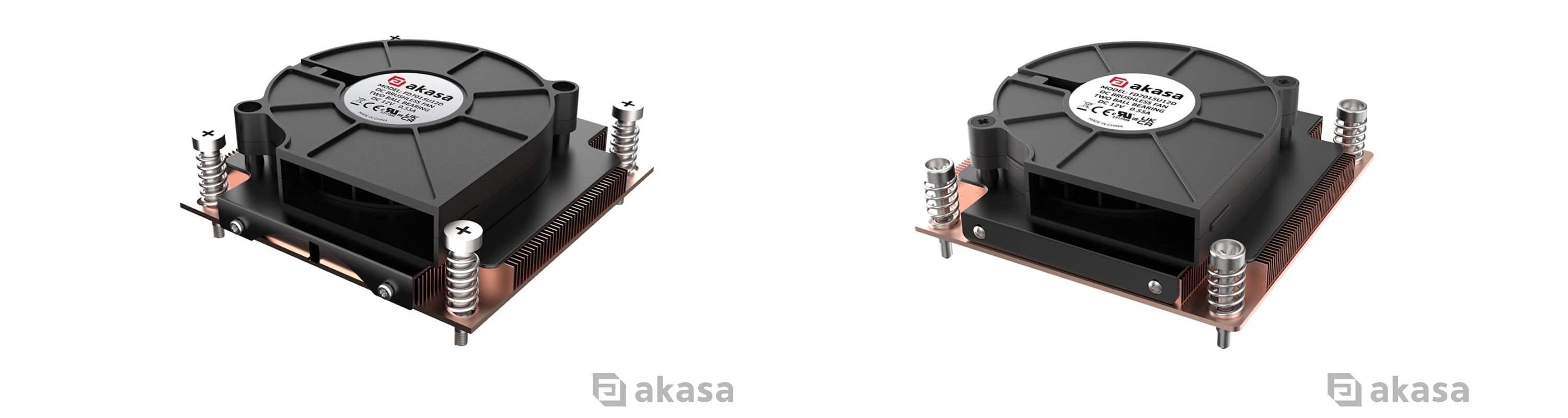
For 1U server builds and edge AI devices demanding higher cooling performance, the Akasa AK-CC7406BP01 handles processors up to 95W TDP with a copper heatsink across a 28.3mm height, supporting Intel sockets from LGA1851 back to LGA775. Where more power-hungry processors are involved, the Akasa AK-CC7409BP01 raises that ceiling to 125W TDP with a copper vapour chamber heatsink within a 29.5mm profile, covering LGA1851 and LGA1700 sockets. Both feature spring-loaded mounting screws and a UL-certified side blower fan with PWM control from 1200 to 5500 RPM and a rated lifespan of 80,000 hours.
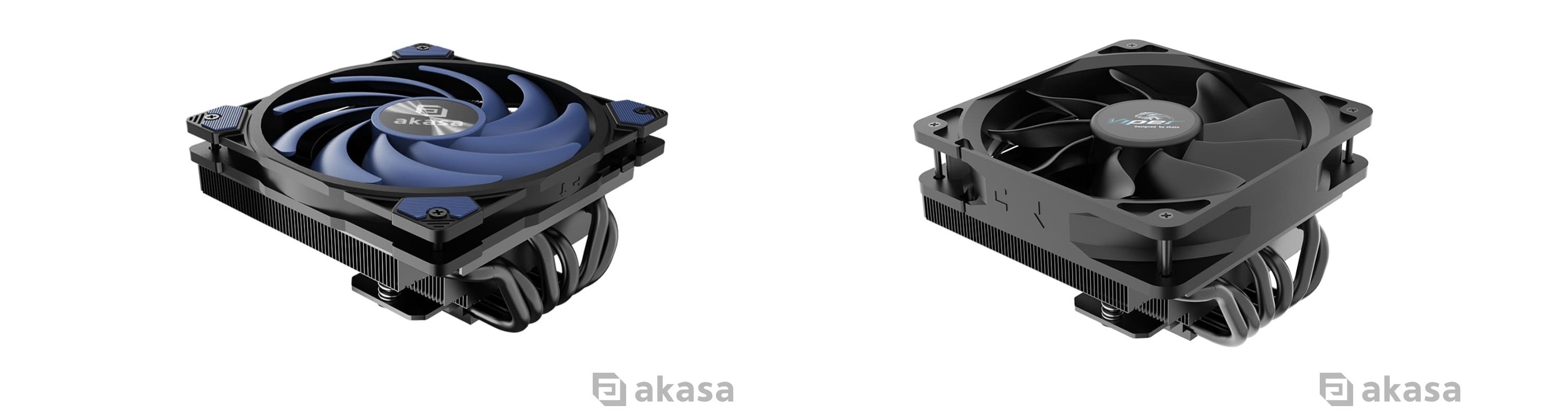
In consumer Mini-ITX and SFF systems running full desktop processors, the Akasa H6L(S) M2 CPU cooler series delivers exceptional performance, supporting CPUs up to 150W-165W TDP. The Alucia H6LS M2, available in Photic Blue and Hadal Black editions, features a space-efficient 67.2mm profile height for cases with sub-70mm clearance restrictions, supporting CPUs up to 150W TDP. For systems running more demanding CPUs, the Viper H6L M2, available in black and white, supports CPUs up to 165W TDP and stands at 76mm tall, using an S-FLOW blade design that delivers up to 30% more airflow at equivalent fan speeds. Gaming and aesthetic-focused builds are well served by the SOHO H6L M2, also available in black and white, which combines vibrant aRGB lighting with capable cooling performance and supports CPUs up to 160W TDP.
Always confirm cooler clearance against your case's published CPU cooler height limit, and verify socket and TDP compatibility against your specific motherboard and processor.
Passive Compact Cooling
Passive cooling eliminates the need for fans entirely. Heat from the CPU is transferred from a heat pipe or thermal module into the case itself, typically a precisely machined aluminium enclosure. Its finned exterior increases surface area, allowing heat to dissipate efficiently into the surrounding air through natural convection and radiation.Fanless designs have practical advantages for many use cases. Removing fans removes the most common mechanical wear point in a PC, which suits industrial deployments, dusty environments and locations where maintenance access is limited. Fanless systems also produce no fan noise and no vibration. In practice, this means quiet, low-maintenance operation when paired with a CPU and workload within the case's supported TDP.
Akasa's Euler series demonstrates two passive approaches:
- The Euler CTX is a compact 3.0L brushed aluminium enclosure for Thin Mini-ITX motherboards. Designed for Intel socket-based Thin Mini-ITX systems up to 35W TDP, it conducts processor heat outward through the chassis fins and uses Akasa's patented spring mounting system for compatibility across a broad range of Thin Mini-ITX boards. Suitable for industrial automation, POS, kiosks, digital signage, education, surveillance, and silent home or office PCs. Supports VESA mounting.
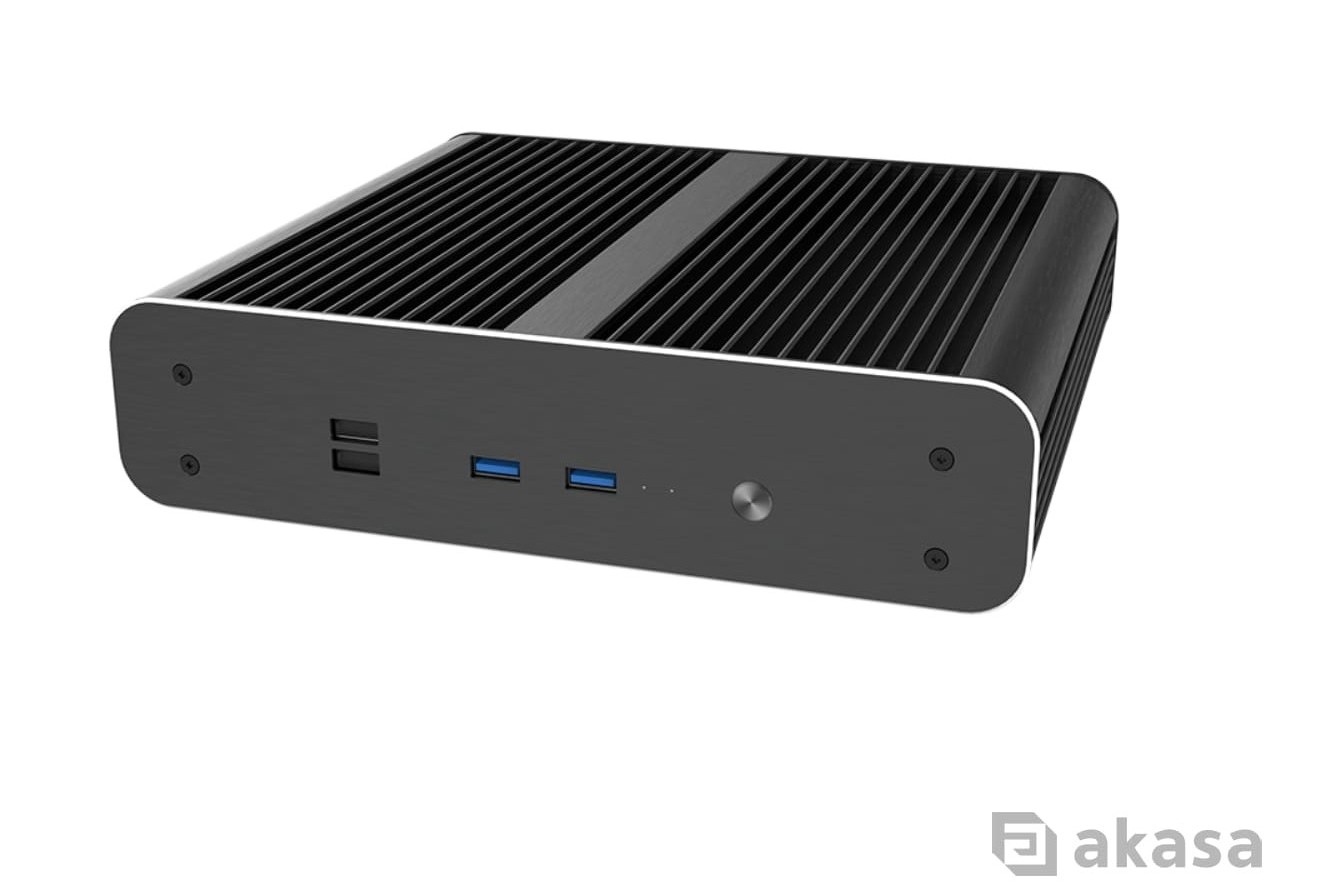
Akasa Euler CTX (Product Code: A-ITX60-S1B)
- The Euler CMX targets Mini-ITX builds in a 4.0L footprint, supporting Intel socket-based processors up to 35W TDP. Also uses Akasa's patented spring mounting system for broad Mini-ITX board compatibility and includes an internal 220W DC-to-DC power adapter (an external power brick is required). Designed for long-life industrial, embedded, and silent home or office applications.
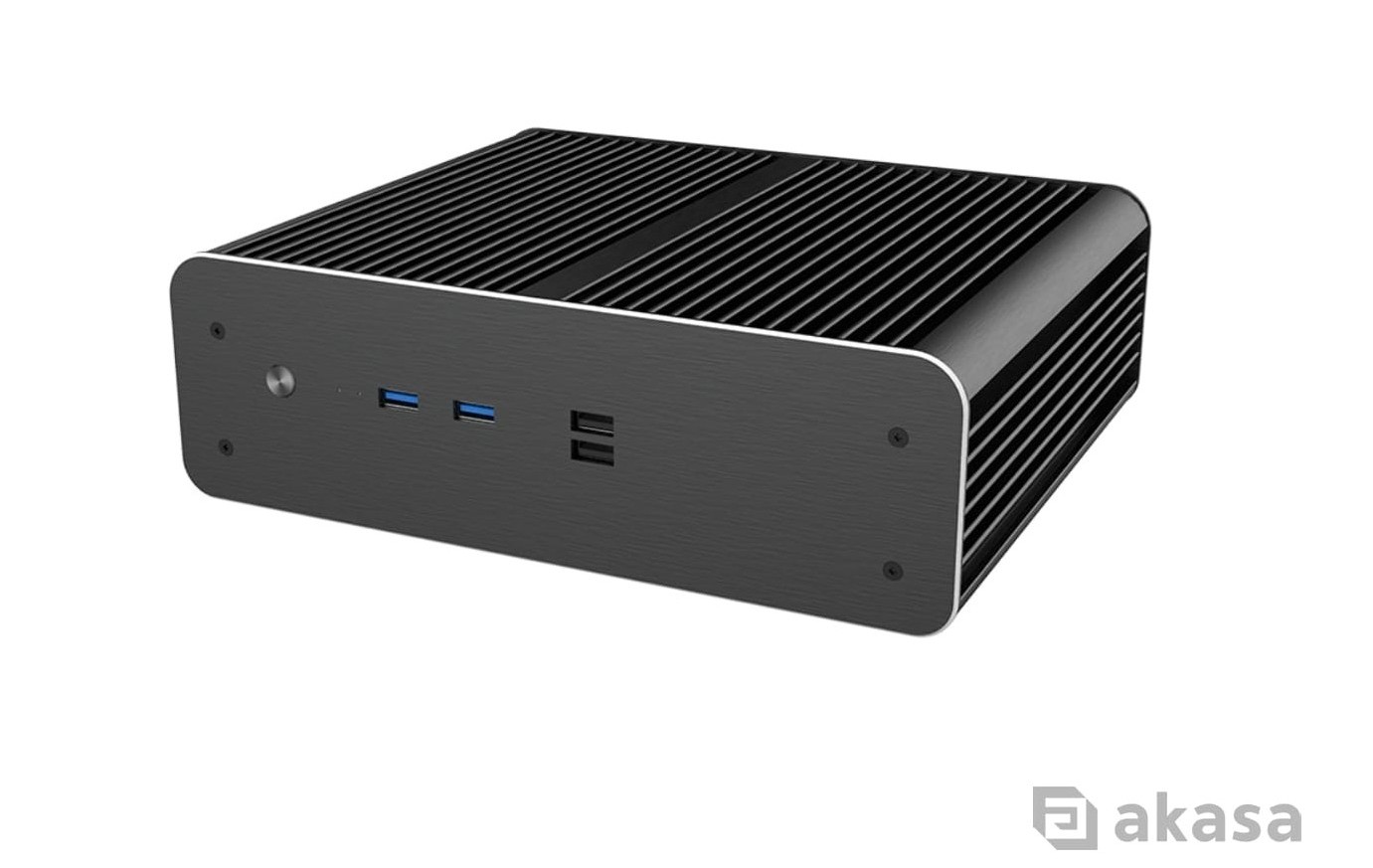
Akasa Euler CMX (Product Code: A-ITX61-S1B)
Why Compact Cooling Is a Harder Engineering Problem Than It Looks
In a standard mid or full tower build, thermal management has plenty of room to breathe. A large heatsink accumulates thermal mass to absorb short bursts of heat, case fans establish a directed airflow path from intake to exhaust and the processor's heat spreads across a wide fin stack to dissipate over a generous surface area.
There are three core challenges to consider when cooling SFF PCs:
- Limited thermal mass: A low-profile heatsink contains significantly less material than a full-size tower cooler, which reduces its capacity to absorb sudden spikes in processor load. Without that buffer, the cooler needs to dissipate heat as fast as it is generated rather than absorbing peaks and recovering between them.
- A compressed heat path: Heat travels from the processor die through the thermal interface material, through the baseplate and into the fin array, all within a much shorter distance than a standard cooler allows. Every interface in that path adds thermal resistance. In a compact design, there is limited opportunity to compensate through additional fin surface area or extended heat pipe routing.
- Constrained airflow: In an active compact build, a small embedded fan operates in tight clearances. Turbulence and recirculation can reduce effective airflow below the fan's rated figure. In a passive design there is no forced airflow at all. The system relies entirely on natural convection, which is slower and more sensitive to ambient temperature.
This is why compact cooling solutions require deliberate choices about heatsink geometry, fin density, contact area, fan placement, case material, and thermal interface design. Each is optimised for the constraints of the target form factor.
Choosing the right compact cooling solution
To help you identify a compact cooling solution for your needs, if you are:Looking for a quiet, low-maintenance, long-life operation with a low-power CPU (≤35W TDP)?
A fanless case like the Euler CTX or Euler CMX is worth considering.
Needing to support a higher-TDP CPU (up to ~125W) in a small chassis?
An embedded-fan cooler with aluminium heatsink, such as the AK-CC6616HP01, covers up to 73W TDP; while a side-blower cooler with copper heatsink, such as the AK-CC7409BP01, extends that to 125W TDP.
Building a consumer Mini-ITX or SFF system with a full-desktop processor up to 150W–165W TDP?
The H6L(S) M2 series, including the Alucia H6LS M2, Viper H6L M2 and SOHO H6L M2, offers options across that range for consumer compact builds.
Always cross-check before buying: motherboard socket compatibility, CPU TDP support, and the case’s maximum CPU cooler height clearance.
If you'd like guidance on choosing the right compact cooling solution for your build or deployment, the Akasa team is happy to help. Get in touch via our contact form.


